
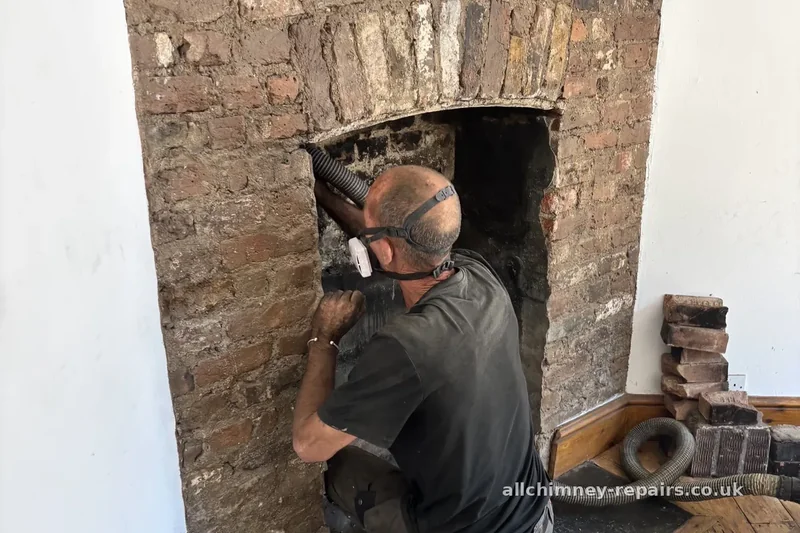
Chimney Lining Inspection Romford & Havering
Smell smoke in a room that should not smell of smoke? Think you may have a chimney leak? We test, inspect and give you a written answer. HETAS registered chimney lining installer. Romford, Hornchurch and Upminster.
Smell Smoke? Think You Have a Leak?
Many flue problems are invisible until they are tested. A smoke smell in a room that has nothing to do with the fireplace, damp patches on or near the chimney breast, unexplained carbon deposits on walls — these are signs that a flue lining has deteriorated or failed and combustion gases are moving through the fabric of the building rather than being safely exhausted through the flue. Carbon monoxide travels the same route. It is not something to leave and it is not something to guess at.
We carry out a full chimney lining inspection, smoke test and written report. You will know exactly what the condition of your flue is and what, if anything, needs to be done. An informed answer based on what we actually find.
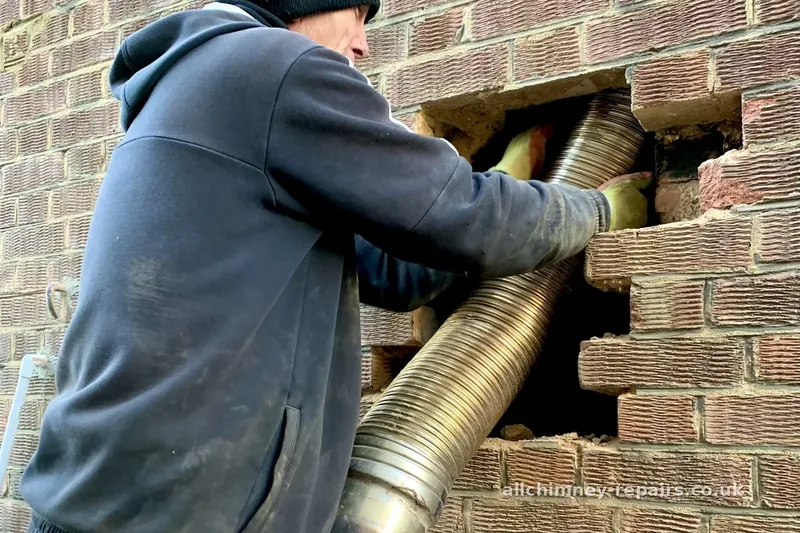
Damaged liner removed through a carefully hand-cut external wall opening — brickwork reinstated on completion. Liner damage caused by loft extension works. HETAS certified chimney lining inspection, Hornchurch.
What Does a Chimney Lining Inspection Cover?
Visual Inspection
At pot level using rope access where needed -- scaffold-free on most properties. Pot condition, flaunching, lead flashing, terminal and cowl condition all checked and documented.
Smoke Test
A smoke pellet establishes whether the flue is sealed and sound. If smoke escapes through brickwork or appears in other rooms, the flue lining is compromised. Results recorded in the written report.
Core Ball Gauge Test
A weighted ball passed through the flue establishes internal diameter and checks for obstructions or offsets. The correct liner diameter cannot be assumed without measurement -- essential before any specification.
Written Report
Findings, condition assessment and recommended action in writing. If no works are needed, we say so. Carried out by a HETAS registered chimney lining installer -- not a builder's opinion.
S/S gather hood fitted at brick gather — 200mm solid fuel open fire lining installed and sealed. HETAS certified chimney lining inspection and survey, Upminster.
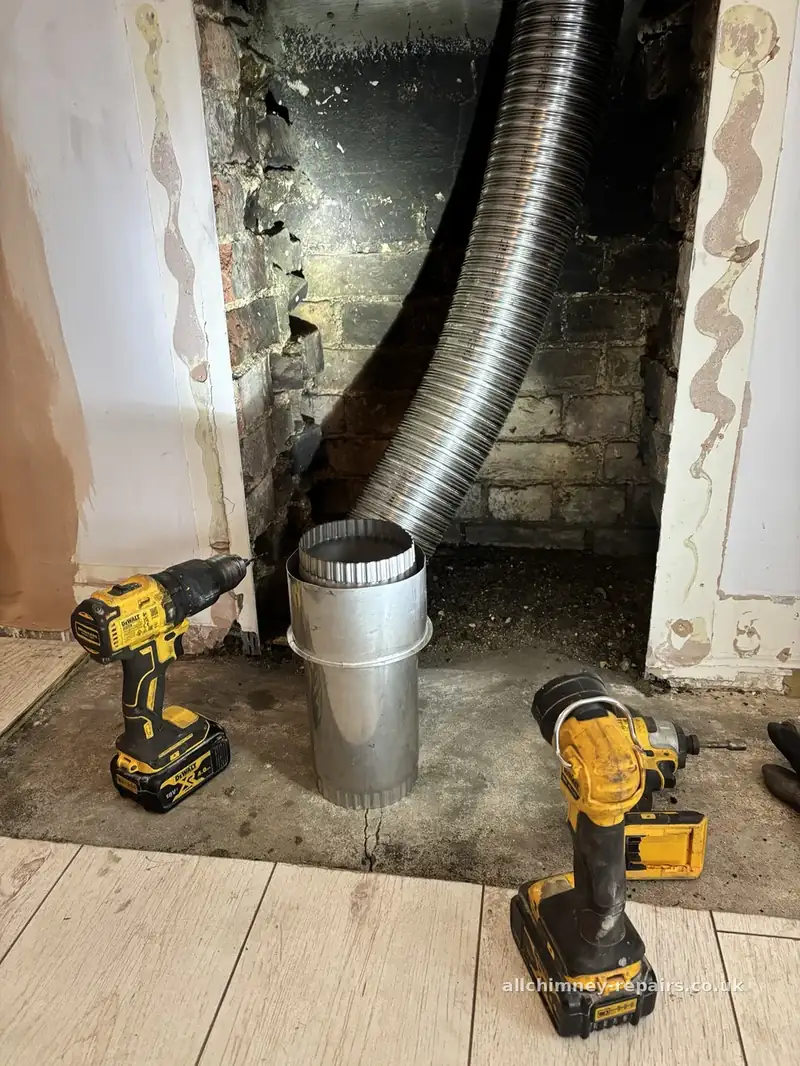
125mm multifuel liner installed through builder's opening — flex adaptor fitted ready for stove pipe connection, constructional hearth shown. HETAS certified chimney lining inspection, Gidea Park Romford.
Lining Types & Specifications
The inspection establishes whether relining is required and, if so, what specification is correct. The chimney liner must be matched to the appliance and fuel type.
125mm or 150mm Class 1 flexible liner is the standard specification for most wood burning stoves, multifuel appliances and wood basket open fires. 316-grade twin wall stainless steel as standard — this grade resists the sulphurous condensates produced by burning wood and coal. Liner fitting involves threading the flexible liner from the pot down to the appliance connection point, fitting a top plate, and sealing the termination correctly.
180mm or 200mm open fire lining with a stainless steel gather hood is the correct specification for open fires. The minimum diameter is 180mm for gas open fires and GFE appliances — a GFE (gas fire emulator) gives the visual effect of a real open fire on gas and requires a correctly specified lining to meet Building Regs. For solid fuel open fires the minimum is 200mm. The extra 25mm is a deliberate safety margin for soot build-up, ensuring draw is not compromised if the chimney is not swept regularly. The S/S gather hood installs within the existing brick gather — where the flue narrows from the opening width to the square brick flue — and is sealed and backfilled to eliminate leakage into the cavity surrounding the liner.
The cavity between the round liner and the square brick flue can be filled with granular insulation — vermiculite is the most commonly used, but it absorbs water. On properties with porous brickwork such as yellow London stocks or soft reds, particularly on end terraces or external wall chimneys, vermiculite increases the risk of internal damp on plastered walls if moisture is present in the stack. Perlite and LECA (Lightweight Expanded Clay Aggregate) are both coarser and have low water absorption — better suited to external wall chimney installations. Worth knowing before specifying insulation on the wrong property.
Class 2 gas flex is the chimney liner specification for gas appliances, including gas back boilers. Thinner and less robust than Class 1 — formerly known as COPEX in the 1970s and 80s. Installing Class 2 with a solid fuel appliance causes premature failure. The correct class for the fuel type is a safety and certification requirement.
All chimney lining installation is HETAS certified and notified to building control. The certificate is issued on completion of every job.
Why HETAS Certification Is Required
HETAS is the competent person scheme for solid fuel and biomass heating systems in England and Wales. Under Building Regulations Part J, any chimney lining work connected to a solid fuel appliance is notifiable -- it must be approved by building control in advance or carried out by a HETAS registered installer who self-certifies.
A HETAS registered chimney lining installer carries out the work, issues the certificate, and notifies building control on the customer's behalf. You do not need to arrange building control approval separately. The certificate is your proof of compliance.
Your insurer will ask for the HETAS certificate if a claim is made relating to the appliance or chimney. Without it, a policy may be voided. Craig Hunter has been HETAS registered since 2003. HETAS company reg 6943, installer reg 23592. The certificate is issued on completion of every liner we fit.
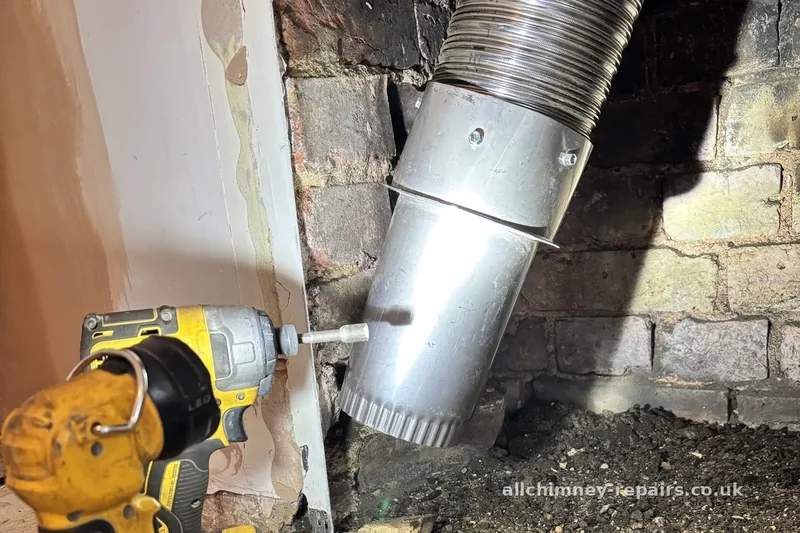
Class 1 multifuel flexible liner fitted with male adaptor — correct specification for solid fuel use. Always install the correct lining class for the intended fuel type. HETAS certified chimney lining inspection, Harold Wood.
What Causes Chimney Lining Failure?
Age and Deterioration
Original clay flue liners in pre-war and early post-war properties deteriorate over decades. Mortar joints in older unlined flues break down progressively. The most common cause across Romford and Havering's 1920s--1950s Fletton LBC and soft red brick chimney stock.
Loft Extension Damage
During loft conversion works, the chimney structure is disturbed -- liner sections cracked, dislodged or removed entirely. The homeowner does not always know it has happened. A chimney performing poorly after building works almost certainly has a damaged liner. We have repaired several via external wall opening to protect finished interiors.
Incorrect Specification
Class 2 gas liner used with a solid fuel appliance corrodes quickly. Wrong diameter restricts draw. A liner not reaching the appliance connection properly leaks at the joint. These are installation errors -- identifiable on inspection and rectifiable with the correct specification.
Previous Poor Installation
Missing top plates, inadequate termination at the pot, unsecured or unsealed liners -- found during inspections where previous work was carried out by unregistered installers. Problems often emerge over months as gaps widen and seals fail.
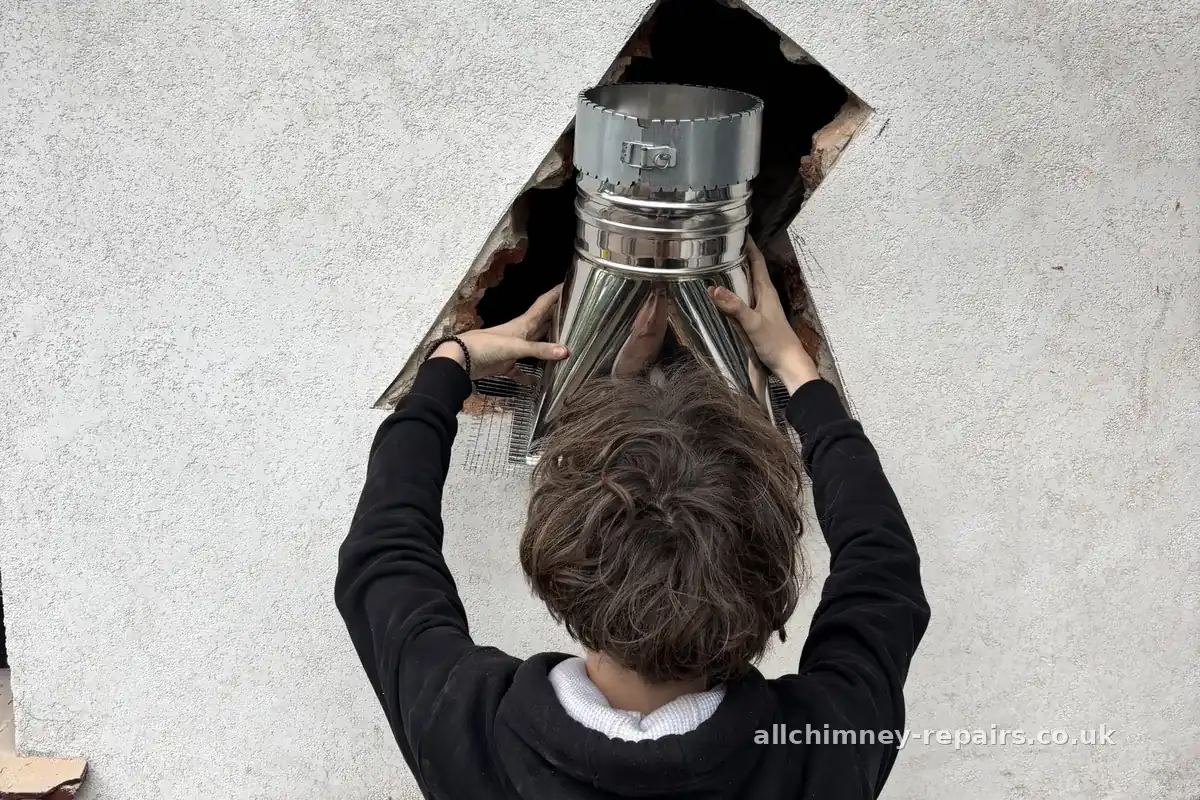
S/S gather hood installed via external wall on an end terrace — all builder's work carried out outside the property, brickwork and render reinstated on completion. HETAS certified chimney lining inspection, Collier Row Romford.
Chimney Lining Inspection FAQ
What does a chimney lining inspection involve?
A full chimney lining inspection covers visual inspection at pot level using rope access where needed, a smoke test to check flue integrity, a core ball gauge test to establish internal flue diameter, and internal inspection where accessible. You receive a written report with findings and recommended action. Carried out by a HETAS registered chimney lining installer.
Why does my chimney smell of smoke even when not in use?
A persistent smoke smell from a chimney not in use often indicates a failed or deteriorated flue lining allowing combustion gases to permeate through the brickwork. It can also result from a blocked flue, downdraught, or a missing cowl. We carry out a full inspection and smoke test to establish the cause before recommending any works.
What is a smoke test for a chimney?
A smoke pellet is placed at the base of the flue and the top is sealed. If smoke escapes through the brickwork or appears in other rooms, the flue lining is compromised. The smoke test is one part of a full chimney lining inspection and results are recorded in the written report.
Do I need HETAS certification for chimney lining in Romford?
Yes. Any chimney lining work connected to a solid fuel appliance is notifiable under Building Regulations Part J. Allchimney Repairs issues HETAS certification and notifies building control on your behalf on every lining job in Romford and across Havering. HETAS company reg 6943, installer reg 23592 Craig Hunter.
Does my chimney need relining?
Not all chimneys require relining. The inspection establishes this clearly before any recommendation is made. Relining is required where the existing liner has failed or deteriorated, where there is no liner in an older unlined flue, or where the liner specification is incorrect. If the liner is serviceable, we say so.
Do you carry out chimney lining inspections in Hornchurch?
Yes. We carry out chimney lining inspections throughout Hornchurch and the surrounding Havering area.
Do you carry out chimney lining surveys in Upminster?
Yes. Chimney lining surveys and flue leak detection in Upminster are part of our standard inspection service.
What causes chimney lining failure?
The most common causes are age and deterioration of original clay linings, damage during loft extensions, failed mortar joints allowing moisture penetration, incorrect liner specification for the fuel type, and previous poor installation with missing top plates or inadequate termination.
Covering Romford, Hornchurch & Upminster
We carry out chimney lining inspections across Romford, Hornchurch and Upminster as our three primary inspection locations, alongside all other areas across Havering. Chimney lining and repairs specialist serving Romford, Hornchurch, Upminster, Gidea Park, Collier Row, Rise Park, Harold Hill and Harold Wood.
Parts of Brentwood and Chadwell Heath also covered -- call to discuss your location.